Views: 0 Author: Site Editor Publish Time: 2026-10-16 Origin: Site


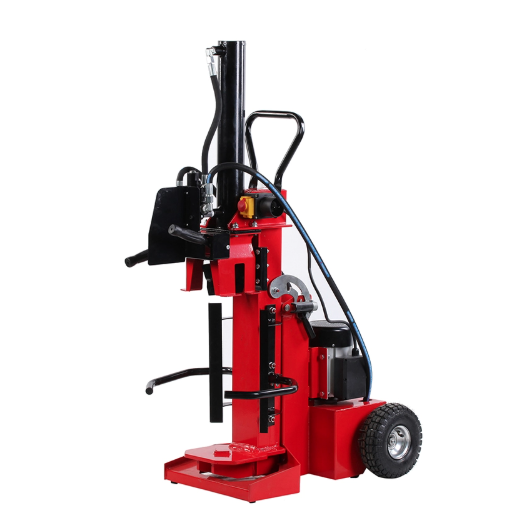
Hydraulic log splitter cycle time is mainly determined by pump flow, hydraulic cylinder dimensions, stroke length, valve operation, available power, and the resistance encountered during splitting. A powerful splitter does not automatically have a fast cycle. In fact, increasing cylinder size to create more splitting force can make the machine slower if pump flow does not increase at the same time.
For buyers comparing a Hydraulic Log Splitter, cycle time should therefore be evaluated together with splitting force, log capacity, pump output, and intended workload. QHM offers different machines through its Log Splitter range, from compact electric models to larger gasoline-powered splitters designed for longer and heavier logs.
Cycle time is the amount of time required for the hydraulic ram to complete its working movement and return to its starting position.
A typical cycle includes:
Ram Extension → Log Splitting → Full or Partial Stroke → Ram Retraction → Ready for Next Log
If a machine takes 8 seconds to extend and 6 seconds to retract, its theoretical full cycle is approximately 14 seconds. Real working productivity, however, will be lower because the operator also needs time to load the log, position it correctly, clear split pieces, and prepare the next piece.
This distinction is important when comparing machines. A manufacturer may publish hydraulic cycle time, but that number does not automatically represent how many logs an operator can process per hour.
Actual firewood output depends on:
Hydraulic cycle time
Log handling time
Number of splits required
Wood hardness
Log diameter
Knot frequency
Wedge design
Operator workflow
Cycle time is therefore an important performance specification, but it is only one part of overall productivity.
Hydraulic pump flow has one of the strongest influences on cycle time.
The pump moves hydraulic oil into and out of the cylinder. Flow is commonly described in liters per minute or gallons per minute. The higher the available flow, the faster the cylinder can fill and therefore the faster the piston can travel, assuming the rest of the hydraulic system can handle that flow.
A simplified relationship is:
Cylinder Speed = Hydraulic Flow ÷ Effective Piston Area
This explains why increasing pump flow can shorten cycle time without directly increasing splitting force.
Pressure and flow should not be confused.
Pressure mainly contributes to force.
Flow mainly contributes to speed.
A splitter with high hydraulic pressure but relatively low pump flow can provide strong splitting force while moving slowly. A machine with higher flow may cycle faster but still need enough pressure and cylinder area to split difficult hardwood.
This is one reason buyers should avoid comparing machines using tonnage alone.
Cylinder bore is the internal diameter of the hydraulic cylinder. A larger bore creates a larger piston area.
At the same hydraulic pressure, a larger piston area generates greater theoretical force. This is why heavy-duty log splitters often use larger cylinders.
However, there is a trade-off.
A larger cylinder also requires a greater volume of hydraulic oil to move the piston through the same distance. If pump flow remains unchanged, the larger cylinder takes longer to fill and therefore moves more slowly.
For example, consider two cylinders with the same stroke and pump flow:
Cylinder Design | Splitting Force Potential | Oil Volume Required | Likely Speed |
|---|---|---|---|
Smaller Bore | Lower | Lower | Faster |
Larger Bore | Higher | Higher | Slower |
Larger Bore + Higher Flow | Higher | Higher | Can remain fast |
This is why a properly designed Hydraulic Log Splitter balances pump size and cylinder diameter rather than maximizing one specification independently.
A buyer who only asks for “more tons” may receive a larger cylinder but unintentionally accept a longer cycle time.
Stroke length determines how far the hydraulic ram can travel.
A longer stroke allows the splitter to accommodate longer logs, but it also increases the volume of oil that must enter and leave the cylinder during every complete cycle.
If two splitters have the same cylinder diameter and pump flow, the machine with the longer stroke will normally require more time to complete a full extension and return.

QHM's Log Splitter BLS04G-105T35 is designed for substantially larger material, with a maximum listed splitting length of 1050 mm and maximum splitting force of 35 tons. A long-stroke machine of this type should be evaluated differently from a compact splitter designed around 500–650 mm firewood.
This trade-off is important when selecting a machine.
If most logs are only 400–500 mm long, an unnecessarily long stroke can add avoidable ram travel. If the operation routinely processes long rounds, however, the additional stroke is necessary.
Some machines reduce wasted travel through adjustable stops or operating techniques that prevent the ram from retracting farther than necessary.
Hydraulic cylinders do not necessarily move at the same speed in both directions.
During extension, hydraulic oil fills the full piston area on the cap side of the cylinder. During retraction, the piston rod already occupies part of the volume on the rod side.
The effective oil volume required during retraction is therefore smaller.
With similar pump flow, this can make the return stroke faster than the forward stroke.
Rod diameter influences this difference. A larger rod reduces the rod-side volume further, which can increase theoretical retract speed.
This means a cycle-time calculation should consider:
Cylinder bore
Rod diameter
Stroke
Extension flow
Retraction flow
Using only cylinder bore and pump GPM can provide an incomplete estimate.
Not directly.
Hydraulic pressure provides the force needed to overcome the resistance of the wood. Increasing pressure does not automatically increase ram speed.
The basic theoretical force relationship is:
Force = Pressure × Piston Area
Cycle speed is more closely related to how quickly hydraulic fluid enters and leaves the cylinder.
This becomes particularly important when a log is difficult to split. The pump may initially move the ram quickly at relatively low pressure. When the wedge reaches a knot or dense grain, system pressure increases because greater force is required.
On some systems, available oil flow then decreases as pressure rises. The ram slows down but develops the force required to continue the split.
Therefore, two machines can have the same maximum pressure but very different cycle times because their pump flow, cylinders, valves, and power sources are different.
Two-stage hydraulic pumps are commonly used in gasoline-powered log splitters because they provide a practical compromise between speed and force.
During low-load movement, both pump sections can contribute flow. The cylinder approaches the log quickly because the hydraulic system does not yet require maximum pressure.
When the wedge encounters significant resistance, system pressure rises. The pump then transitions so that a lower-flow stage can generate higher pressure without requiring an excessively large engine.
The sequence is approximately:
Low Resistance → High Flow → Fast Ram Travel
High Resistance → Lower Flow → Higher Pressure → Strong Splitting Force
Log Splits → Resistance Falls → Higher Flow Resumes
This allows the machine to avoid moving slowly at maximum-force conditions throughout the entire stroke.
However, real cycle time depends on how long the splitter remains in each operating stage. Easy straight-grain wood may split while the pump remains in high-flow operation for most of the stroke. A dense knotty log can keep the system in its high-pressure, lower-flow condition for longer.
Published no-load cycle time therefore does not tell the entire story.
The control valve has a major effect on how efficiently the operator completes each cycle.
A basic directional valve controls whether oil extends or retracts the cylinder. Log splitters often use valves that provide detent or automatic-return functionality, allowing the operator to release the lever while the ram returns.
Auto return does not necessarily increase hydraulic flow, but it can improve practical productivity because the operator can use the return time to prepare the next log or clear split pieces.
Valve flow capacity is also important.
If the pump is capable of supplying high flow but the valve has undersized internal passages, the valve can restrict oil movement. The result can be slower cylinder travel, additional pressure loss, and unnecessary heat.
A complete hydraulic system should therefore match:
Pump Flow → Valve Capacity → Hose Size → Cylinder Ports → Cylinder Volume
A high-flow pump alone cannot create a fast machine when downstream components restrict that flow.
The hydraulic pump needs mechanical power.
In gasoline splitters, an engine drives the pump. In an Electric Log Splitter, an electric motor performs the same basic function. A hydraulic system cannot simultaneously deliver unlimited pressure and unlimited flow because both require input power.
Hydraulic power increases as both flow and pressure increase. A higher-flow pump therefore requires sufficient engine or motor output, particularly when operating under pressure.
This creates another design trade-off:
Higher Flow + High Pressure = Greater Power Requirement
If the engine is too small for the selected pump, it may lose speed or stall as hydraulic pressure rises. Pump flow then decreases and actual cycle performance becomes inconsistent.
Electric machines face the same principle. Their motor output, electrical supply, pump capacity, and hydraulic pressure must be matched.

For example, QHM's Log Splitter VLS02E-65T12 uses an electric hydraulic system, offers a listed 12-ton maximum splitting force, handles logs up to 650 mm long, and lists a cycle of approximately 20 seconds. This type of machine prioritizes convenient electric operation and moderate firewood processing rather than simply pursuing the shortest possible commercial cycle time.
Even a correctly sized pump and cylinder can perform poorly if oil cannot move freely through the rest of the hydraulic circuit.
Restrictions can occur in:
Hydraulic hoses
Elbows
Quick couplers
Control valves
Filters
Suction lines
Return lines
Cylinder ports
An undersized hose increases flow resistance. A dirty filter can also create pressure loss, while a restricted suction line may prevent the pump from receiving enough oil.
These losses convert useful hydraulic energy into heat.
If a splitter initially cycles normally but becomes slower after extended use, the problem may not be the cylinder or pump. Hydraulic temperature, filter condition, oil level, hose condition, or other restrictions should also be checked.
Buyers evaluating a machine should therefore consider system design rather than treating the pump's advertised flow as guaranteed flow at the cylinder.
Hydraulic oil viscosity changes with temperature.
When oil is very cold, it becomes thicker and flows less easily through pumps, hoses, valves, and filters. The splitter may cycle more slowly until the system reaches a normal operating temperature.
When oil becomes excessively hot, it becomes thinner. Very low viscosity can increase internal leakage inside the pump, valve, or cylinder and reduce volumetric efficiency. Excessive heat can also accelerate seal and oil degradation.
A correctly sized reservoir helps the system manage temperature by providing enough oil volume and cooling surface.
Operators should use hydraulic oil with viscosity appropriate to the manufacturer's specifications and expected ambient temperature.
Changing to extremely thin oil simply to gain speed is not a proper way to shorten cycle time.
Yes. The theoretical hydraulic cycle and the actual splitting cycle are not always the same.
Straight-grain softwood may separate quickly once the wedge enters the log. Dense hardwood, twisted grain, large knots, crotches, and partially frozen wood can require substantially more resistance.
When resistance increases, hydraulic pressure rises. On systems using staged pump operation, higher pressure may cause the pump to move into a lower-flow mode.
The ram then travels more slowly until the difficult section splits.
Wood characteristics that can influence working time include:
Species
Moisture content
Diameter
Length
Knotting
Grain direction
Crotches
Previous drying
Temperature
This means manufacturers' cycle figures should be treated as machine-motion specifications rather than guaranteed splitting times for every piece of wood.
Indirectly.
A machine rated for higher splitting force often uses a larger cylinder, higher pressure, or both. A larger cylinder can create more force but also requires more hydraulic oil per stroke.
If pump capacity is not increased accordingly, cycle time becomes longer.
This creates the basic design compromise:
Design Goal | Typical Hydraulic Change | Possible Result |
|---|---|---|
More Force | Larger Cylinder | Slower cycle if flow stays constant |
Faster Cycle | Higher Pump Flow | Greater power requirement |
Longer Log Capacity | Longer Stroke | Longer full cycle |
Faster Return | Rod-side volume optimization | Reduced return time |
Heavy-Duty Splitting | High pressure + large bore | Greater load on components |
There is therefore no universal “best” cycle time.
A compact splitter used for small firewood may benefit greatly from faster ram movement. A heavy-duty machine handling very large timber may reasonably accept a slower stroke in exchange for greater force and longer log capacity.
A simplified estimate starts with cylinder volume and pump flow.
For extension:
Extension Time ≈ Cap-End Cylinder Volume ÷ Pump Flow
For retraction:
Retraction Time ≈ Rod-End Cylinder Volume ÷ Pump Flow
Then:
Cycle Time ≈ Extension Time + Retraction Time
The cap-end volume depends on cylinder bore and stroke.
The rod-end volume depends on bore, rod diameter, and stroke.
However, this calculation gives only an ideal hydraulic estimate. Real machines experience:
Pump efficiency losses
Valve restrictions
Hose losses
Flow changes with pressure
Engine RPM variation
Two-stage pump transitions
Mechanical friction
Oil temperature changes
It is therefore better to use the calculated value for comparison rather than treating it as an exact real-world guarantee.
There is no single number that suits every application.
A homeowner splitting a few cubic meters of firewood each season may value quiet operation, compact size, and simple maintenance more than saving several seconds per cycle.
A commercial firewood processor can place much greater value on short cycle times because a difference of several seconds repeated hundreds of times per day affects total output significantly.
The appropriate cycle time should therefore reflect the workload:
Application | Main Priority |
|---|---|
Occasional Home Use | Simplicity and sufficient force |
Small Woodlot | Balanced force and cycle speed |
Farm Use | Versatility and reliability |
Landscaping | Portability and reasonable productivity |
Firewood Business | Fast repeat cycles |
Large Timber | High force and long stroke |
Commercial Production | Cycle speed + handling efficiency |
QHM's wider Forestry Machinery range supports different wood-processing tasks, so splitter selection can be based on the actual forestry workflow rather than one isolated specification.
Reducing cycle time does not always require modifying the hydraulic system.
One of the simplest improvements is avoiding unnecessary full stroke. If a 650 mm splitter is repeatedly processing 300 mm logs, returning the ram through the entire unused distance wastes time.
Correct log positioning also matters. Placing the log securely against the wedge reduces time spent realigning material during the split.
A sharp and properly maintained wedge can reduce resistance, particularly with relatively straight-grain wood. Hydraulic oil, filters, hoses, engine speed, and fluid level should also remain within normal specifications.
Useful operating practices include:
Match log length to machine stroke.
Avoid unnecessary full ram travel.
Keep hydraulic fluid at the correct level.
Replace restricted filters.
Inspect hoses and fittings.
Maintain the correct engine operating speed.
Keep the wedge in suitable condition.
Clear split wood while auto return operates, where the machine design permits.
Keep logs staged close to the work area.
For high-volume production, material handling can save as much time as increasing hydraulic speed.
Hydraulic modifications should be approached carefully.
Installing a larger pump may appear to be an easy way to increase speed, but the engine, valve, hoses, filter, reservoir, fittings, and cylinder ports all need to handle the additional flow.
If they cannot, the modification may create:
Excessive heat
Engine overload
Pump cavitation
High back pressure
Valve restrictions
Premature component failure
Changing cylinder diameter also alters both speed and force.
Reducing bore can make the ram faster at the same flow, but it also reduces available splitting force. Increasing bore does the opposite.
The correct approach is system matching rather than changing one component independently.
When purchasing a splitter, compare more than the published number of seconds.
Ask for the following specifications:
Specification | Why It Matters |
|---|---|
Full Cycle Time | Basic speed comparison |
Splitting Force | Indicates force class |
Pump Flow | Major influence on travel speed |
Maximum Pressure | Part of force calculation |
Cylinder Bore | Affects force and oil volume |
Rod Diameter | Affects return-side volume |
Stroke Length | Affects total travel |
Log Length Capacity | Determines required stroke |
Engine/Motor Power | Must support hydraulic demand |
Auto Return | Improves operator workflow |
Valve Flow Rating | Must handle pump output |
Reservoir Capacity | Influences cooling |
Machine Orientation | Affects handling efficiency |
Two machines with similar advertised tonnage may perform very differently because their hydraulic architecture is different.
A buyer processing large quantities of small, straight firewood may reasonably prioritize cycle speed. A buyer regularly processing large hardwood rounds may value greater splitting force even if the cycle is somewhat longer.
QHM provides log splitters for different firewood and forestry applications rather than relying on one configuration for every user.
Its current product range includes electric, gasoline, kinetic, horizontal, and vertical designs with different splitting-force and log-size capacities. This gives buyers the ability to select equipment around workload, available power, operating environment, and required log size.
For example, the VLS02E-65T12 provides electric hydraulic operation with a maximum listed splitting force of 12 tons and a 650 mm log-length capacity. The BLS04G-105T35 is a much larger gasoline-powered hydraulic splitter rated for up to 35 tons of splitting force and logs up to 1050 mm long.
These examples illustrate an important principle: the correct machine depends on what needs to be split.
A small Electric Log Splitter can make sense for regular residential or light commercial firewood preparation, while a larger Hydraulic Log Splitter configuration is more appropriate when longer, wider, or more difficult timber must be processed.
When comparing QHM models, buyers should provide expected log species, diameter, length, annual workload, preferred power source, and required production rate so cycle speed and splitting force can be considered together.
Hydraulic log splitter cycle time is determined by the interaction between pump flow, cylinder bore, rod diameter, stroke length, valve design, hydraulic pressure, available power, hose and filter restrictions, oil condition, and wood resistance.
Pump flow has the most direct influence on how quickly the cylinder moves. Cylinder size determines how much oil must be moved and also affects available splitting force. Longer stroke increases travel time, while two-stage pumps and automatic return systems can improve practical working efficiency.
Pressure should not be confused with speed. Higher pressure provides greater potential splitting force, but faster operation normally requires sufficient hydraulic flow. Increasing cylinder size to gain tonnage without increasing flow can actually make a machine slower.
The correct splitter therefore balances:
Splitting Force + Pump Flow + Cylinder Size + Stroke + Power + Real Workload
QHM offers different log splitter configurations for residential, farm, woodlot, landscaping, and heavier wood-processing applications. When selecting a machine, compare cycle time together with log diameter, log length, wood type, power source, and daily production requirements rather than choosing solely by advertised tonnage.
The main factors are hydraulic pump flow, cylinder bore, rod diameter, stroke length, control valve design, engine or motor power, system restrictions, and the resistance of the wood being split.
No. Pressure primarily determines available force when combined with piston area. Hydraulic flow has a more direct influence on cylinder speed.
Generally, yes. More hydraulic flow fills and empties the cylinder faster, provided the engine, valve, hoses, filter, and other components can handle the increased flow.
A larger bore contains more oil. At the same pump flow, it takes longer to fill and empty, although the larger piston area can generate more splitting force.
Yes. A longer stroke requires the ram to travel farther and requires more hydraulic fluid for each complete extension and return.
The cylinder rod occupies space on the rod side of the piston, so less oil volume is required for retraction. With similar flow, this can make the return stroke faster.
A two-stage pump can provide high flow during low-resistance travel and switch to lower flow at higher pressure when greater splitting force is needed.
No. Very fast operation is useful for high-volume firewood production, but heavy-duty splitting may require larger cylinders and longer strokes. Force, log capacity, durability, and handling should also be considered.
Excessive oil temperature can reduce viscosity and increase internal hydraulic leakage. Filters, fluid condition, oil level, cooling, and component wear should be checked if performance changes significantly.
Yes. A restricted filter can reduce hydraulic flow, increase pressure loss, generate heat, and slow cylinder movement.
It can affect the real working cycle. Difficult hardwood, knots, twisted grain, and crotches require higher splitting pressure and may keep the hydraulic system in a slower high-pressure operating condition for longer.
Compare splitting force, pump flow, cylinder size, stroke, maximum log length and diameter, power source, machine orientation, auto return, hydraulic system design, portability, and intended workload.


